
-
About Us
-
Metal Fabrication Processes
Precision Sheet Metal Bending Laser Cutting Stamping Welding Surface Treatment -
Contact Us
The BESS (Battery Energy Storage System) cabinet is the core housing for commercial, industrial, and utility-scale energy storage. Inside it sit battery modules, the BMS, PCS converters, thermal management systems, and fire suppression equipment — precision components that are all afraid of water, impacts, and corrosion. Their only line of defense is a sheet metal enclosure.
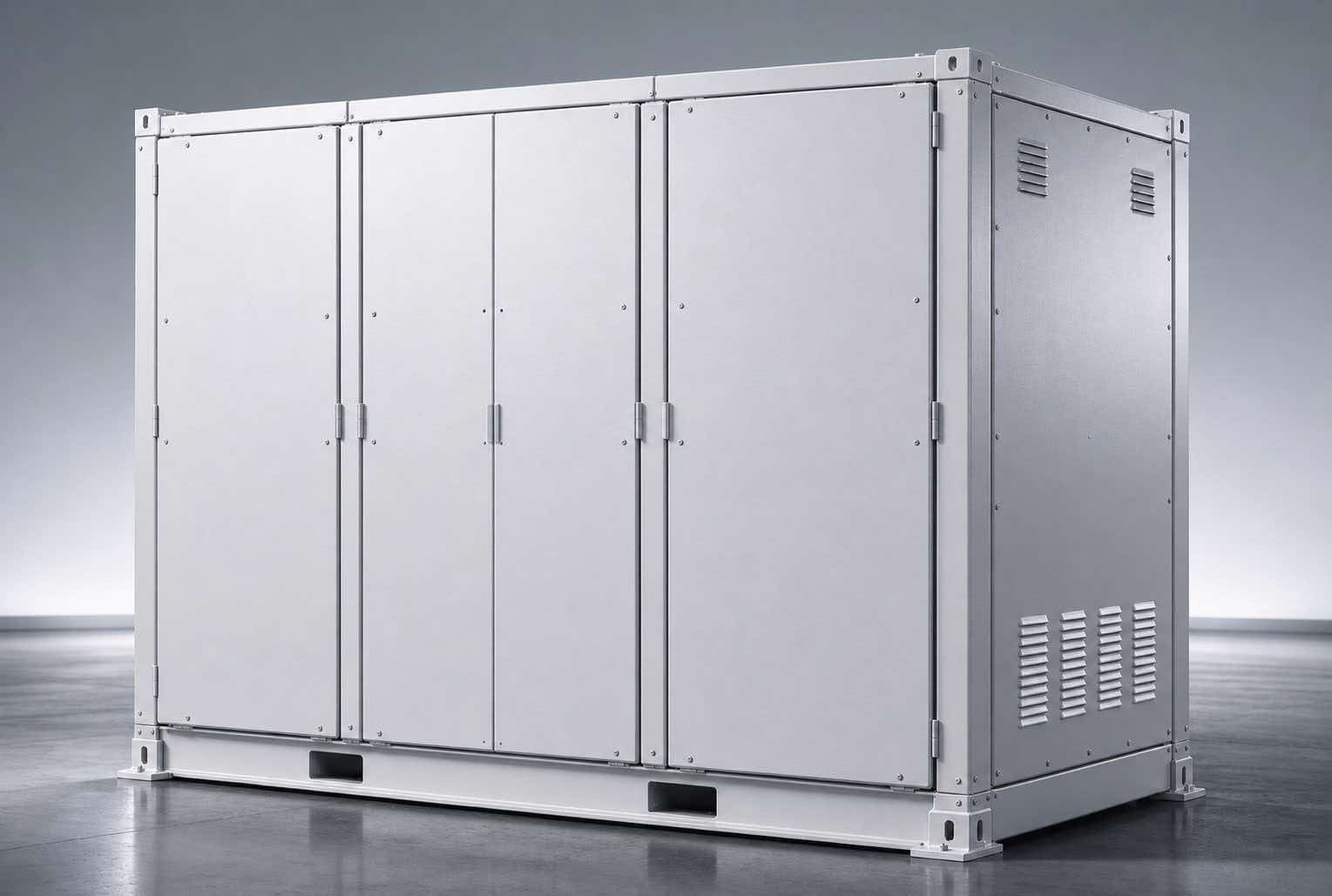
How fierce is the 2026 storage boom? Global energy storage cabinet exports grew around 68% year over year, with China accounting for 45% of global exports. With European utility-scale storage grid connections, Middle East new-energy investment, and Southeast Asian solar-plus-storage projects all surging at once, top manufacturers' storage cabinet orders have already been booked into early 2027. Storage cabinet sheet metal is currently the hottest single category in the entire metal fabrication industry.
Component | Thickness | Function |
Cabinet frame (posts, beams) | 2.0–3.0 mm | Load-bearing skeleton; carries modules and supports lifting |
Doors (front/rear/side) | 1.5–2.0 mm | Sealed protection + service access; often foam-insulated |
Cooling duct / louver | 1.2–1.5 mm | Thermal airflow management, works with AC or air cooling |
Battery module mounting rails/brackets | 2.0–3.0 mm | Module load bearing and fixing |
Explosion relief panel | 1.5 mm | Directional pressure venting on thermal runaway, protects adjacent cabinets |
Cable trays, covers, base | 1.0–2.0 mm | Cable management, pest-proofing, waterproof sealing |
Indoor / general outdoor (mainstream): SGCC hot-dip galvanized steel — solid corrosion base, best cost-performance, accounts for the bulk of storage cabinet orders.
High-humidity, high-salinity coastal / Middle East (upgrade): 304 stainless steel — handles 500+ hours of salt spray with ease; higher unit price but lower total cost of ownership.
Lightweight needs (special): 5052 / 6061 aluminum alloy — significant weight reduction, but welding and cost barriers are high; mainly used for weight-sensitive mobile storage.
The dividing line between indoor and outdoor cabinets is the protection rating: IP20–IP30 is fine indoors, but outdoor must start at IP54, with IP55 recommended for humid coastal areas. This directly determines door gasket structure, bending precision, and coating process complexity.
Standard process chain: fiber laser cutting → CNC bending → robotic welding (frame) → weld dressing → pretreatment (ceramic conversion) → electrostatic powder coating → inspection & assembly.
Challenge 1: Welding distortion control. Dense welds on a 3.0 mm frame will twist the whole structure if heat isn't managed, and doors won't fit. Requires fixtures, a symmetrical welding sequence, and leveling when necessary.
Challenge 2: Balancing sealing and heat dissipation. IP54 demands every door seam and cable entry be sealed, yet battery heat demands ventilation. Duct design and labyrinth-style venting are where a fabricator's experience shows.
Challenge 3: Batch consistency. Storage projects often involve hundreds or thousands of cabinets; door gap uniformity must be identical from unit #1 to unit #1000 — a test of equipment repeatability and standardized process parameters.
Challenge 4: Weatherability of surface treatment. Outdoor cabinets require 500+ hours of salt spray resistance. Standard indoor powder simply can't survive; outdoor-grade polyester powder and, for critical parts, a three-layer coating (galvanizing + primer + topcoat) are mandatory.
A storage cabinet is a "structure + protection + load-bearing" product in one. When selecting a supplier:
Check process completeness — cutting, bending, welding, and coating must be closed-loop in-house. Shops that only cut and outsource the rest lose control of both lead time and quality. A source factory like Fengrun Hardware Factory, which handles laser cutting, CNC bending, welding, and surface treatment all in-house, completes a storage cabinet from blanking to shipment under one roof. Its quote is a true "landed total cost" with no mid-project markups, and lead times for large orders can be committed in writing.
Custom-from-drawing/sample capability — storage cabinet structures differ by manufacturer standard. A factory that can prototype 1:1 directly from your drawings or 3D models minimizes communication cost. Fengrun Hardware Factory seamlessly switches between small-batch trial production and mass production, fitting the "validate first, then scale" rhythm of project-based customers.
Multi-material switching capability — a factory that works with galvanized steel, stainless steel, and aluminum can flexibly change materials to match your project environment (indoor/outdoor/coastal) without forcing you to find a new supplier.
The storage industry's certainty over the next five years is exceptionally strong, and the order dividend for storage cabinet sheet metal keeps flowing. For buyers, the earlier you lock in a source fabrication factory with mature processes and full-process control, the more leverage you hold at every project delivery milestone — after all, in a category booked out into next year, capacity and lead time are the real hard currency.
Need a custom enclosure for your energy storage project? Bring your drawings and let's talk. Fengrun Hardware Factory offers custom sheet metal fabrication for the full range of BESS battery cabinets — one-stop delivery from prototyping to mass production.
From prototype to production — high-precision sheet metal solutions with fast turnaround and consistent quality


