
-
About Us
-
Metal Fabrication Processes
Precision Sheet Metal Bending Laser Cutting Stamping Welding Surface Treatment -
Contact Us
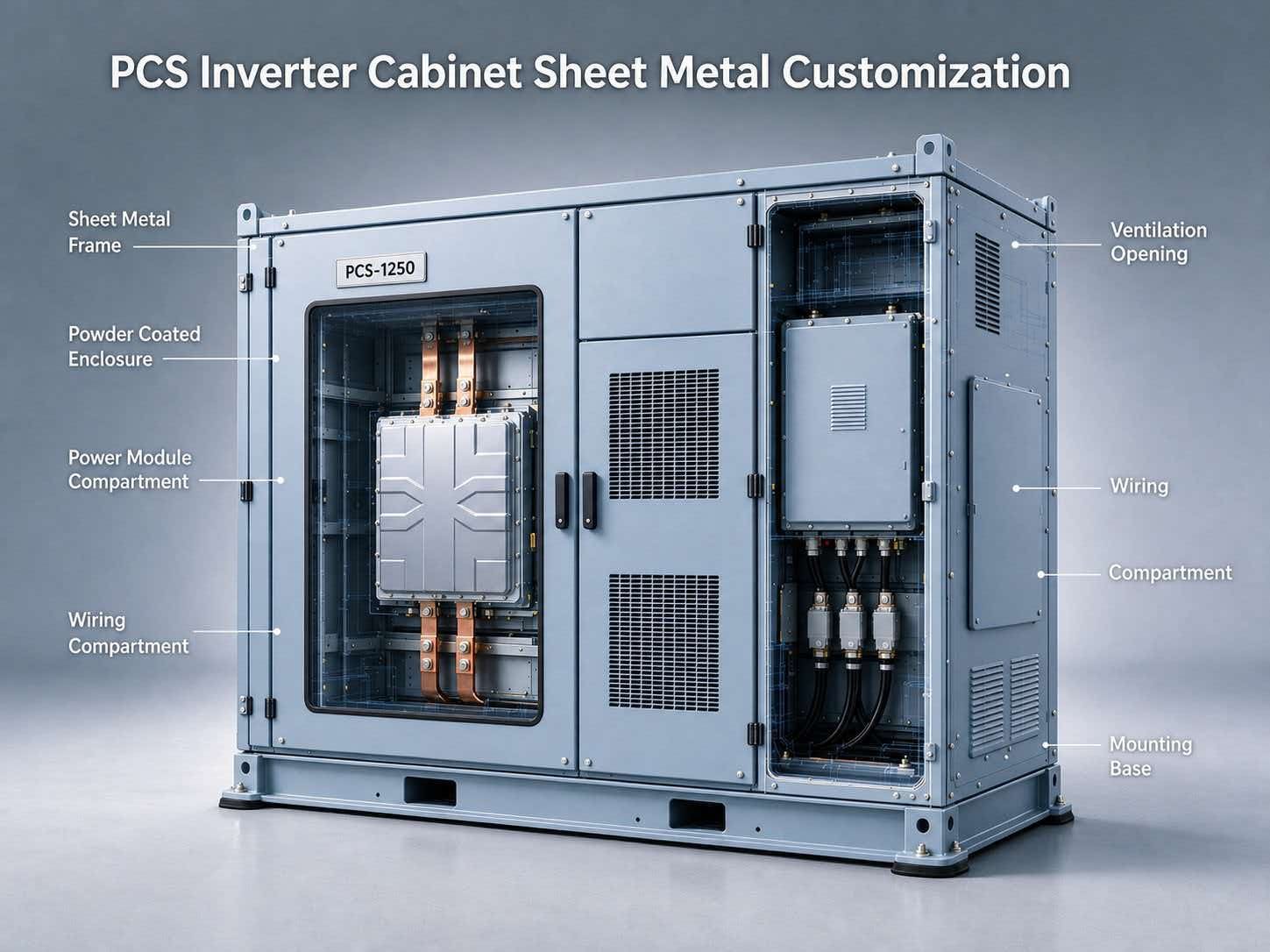
The PCS (Power Conversion System) handles bidirectional conversion between the battery's DC power and the grid's AC power. It is one of the highest-heat-generating and most electrically demanding components in an energy storage system. A PCS cabinet enclosure isn't just a "shell" — it must simultaneously deliver four functions: electromagnetic shielding (EMC), forced-air cooling, dust/water protection, and insulation/isolation. It is a classic high-barrier electrical sheet metal part.
Within the storage sector's overall growth of roughly +65% to +75% in 2026, PCS cabinets are scaling alongside storage cabinets. Middle East and Southeast Asian outdoor projects show especially strong demand for IP55-rated PCS enclosures.
Component | Thickness | Design Points |
Cabinet frame | 2.0 mm | Carries heavy items like transformers and reactors; base needs reinforcement |
Double-layer doors | 1.5 mm | Double-wall structure with built-in EMC conductive gasket to prevent electromagnetic leakage |
Vent panel / louver | 1.5 mm | Punched holes + dust screen, balancing airflow and IP rating |
Electrical mounting rails | 2.0 mm | Galvanized or locally exposed conductive grounding after coating |
Waterproof cable-entry gland plate | 2.0 mm | Openings + seals; the critical part for outdoor IP55 |
Compared with an ordinary distribution cabinet, the PCS cabinet adds three core designs: an EMC conductive gasket (leak-proof door seams), a directional air duct (fan + vent panel combination), and insulation divider panels (separating high- and low-voltage zones).
Mainstream: SGCC hot-dip galvanized steel — good conductive grounding (needed for EMC), solid corrosion base, controllable cost; accounts for over 80% of PCS cabinet orders.
Coastal / desert outdoor: 304 stainless steel — for the Middle East's high-salt-spray and high-temperature-differential environments; stainless steel plus outdoor-grade powder coating delivers longer service life.
Lightweight scenarios: aluminum alloy — less common, mainly for small residential low-power PCS units.
Typical thickness combination: 2.0 mm frame, 1.5 mm doors, 2.0 mm mounting rails. Slightly thinner than indoor storage cabinets, but with higher demands on flatness and hole-position accuracy — because power modules, fans, and busbars use blind-mate designs; a 1 mm hole offset makes them impossible to install.
Process chain: combined laser cutting + CNC punching → bending → welding/riveting (studs, EMC gasket grooves) → coating → assembly & inspection.
Challenge 1: Achieving both cooling vents and structural strength. The higher the open ratio of a vent panel, the greater the airflow — but the weaker the structure. Mature solutions use louver-style rainproof structures or circular-hole arrays with reinforcing ribs, requiring simultaneous design of bending and forming.
Challenge 2: EMC conductive treatment. Powder coating is insulating, so every area requiring conductive grounding (gasket contact faces at door seams, grounding stud holes) must be locally masked during coating or scraped clear afterward. Miss one spot, and the whole cabinet fails electromagnetic testing.
Challenge 3: Batch hole-position consistency. Blind-mate holes, fan holes, and gland holes can number in the dozens. At high volumes, punch-die wear and laser parameter drift both cause hole-position shift, requiring full first-article inspection plus a controlled sampling frequency.
The cost of reworking a PCS cabinet is extremely high — scrapping the enclosure means stripping and refitting all internal electricals. When vetting a factory, focus on:
Experience delivering similar electrical cabinets. Manufacturers who have made storage cabinets, distribution cabinets, and telecom cabinets have muscle memory for electrical details like EMC, grounding, and sealing hole positions. Fengrun Hardware Factory covers electrical sheet metal categories including power cabinets, telecom cabinets, and storage-system accessories; when customizing from drawings, it proactively flags easy-to-miss items such as hole tolerances and masked coating.
Combined blanking capability. Vent panels must be punched on a CNC turret press (laser-cut holes are slow and leave dross). A manufacturer with both laser cutting and CNC punching equipment delivers on efficiency and quality alike.
Coating-mask process. Conductive zones are masked with manually applied protection, so diligence determines yield. A factory with full in-house process control — a source factory like Fengrun Hardware Factory that never sends processes out — masks parts on its own coating line, keeping responsibility unambiguous and avoiding the "who's to blame for a missed mask" disputes that arise with outsourced coaters.
The PCS cabinet is a category where "electrical requirements are wrapped inside sheet metal." Choosing the right supplier is like double-insuring your project. In a boom year for storage, capacity with hands-on electrical sheet metal experience is the resource most worth locking in early.
PCS converter cabinets and energy-storage electrical cabinets — bring your drawings and ask for a quote. Fengrun Hardware Factory offers custom fabrication for the full range of electrical sheet metal parts, with cutting, punching, bending, welding, and coating completed in one stop.
From prototype to production — high-precision sheet metal solutions with fast turnaround and consistent quality


