

-
About Us
-
Metal Fabrication Processes
Precision Sheet Metal Bending Laser Cutting Stamping Welding Surface Treatment -
Contact Us
If the BESS battery cabinet is the skeleton of a storage system, then battery module brackets are the joints of that skeleton — every storage cabinet contains dozens to hundreds of module brackets, precisely fixing cell modules to the cabinet posts. Measured by volume, they are the fastest-moving category in the entire energy storage sheet metal chain: a single 100 MWh storage project consumes module brackets in the tens of thousands of pieces.
Module brackets are a classic case of "small part, big business": the unit price is low and the structure is not complex, but tolerance requirements and batch consistency requirements are extremely high — because they stack in layers inside the cabinet, and a single hole-position deviation on any one part will jam on-site assembly.
Type | Typical Structure | Characteristics |
Stamped-and-bent type | Flat plate bent into L/U shapes + punched holes | Highest volume, lowest cost |
Welded-assembly type | Bent parts welded to tube/section material | High load capacity, for heavy modules |
Elastic clip type | Spring tab + locating features | Tool-free installation, high assembly efficiency |
Mainstream: SGCC galvanized steel / SPCC cold-rolled steel, 1.5–2.5 mm — the balance of conductivity (needed for equipotential bonding), cost, and strength.
EV power modules: SPCC with nickel plating, or 5052 aluminum alloy — lightweight-oriented.
Special case: pre-coated galvanized sheet — eliminates the coating step entirely; punched and bent, then shipped as-is, cutting cost by another notch.
There is a hidden logic in material selection: module brackets usually need to be conductive (grounding / equipotential bonding), so coating must either be locally masked, or galvanized sheet is used uncoated straight from the press. Non-specialized fabricators often miss this point.
High-volume route: CNC punching (NCT) for holes and contours → bending → press-fit nuts → shipped uncoated (galvanized sheet). Lowest per-piece cost; suited to orders in the tens of thousands of pieces.
Small-to-mid batch / development route: fiber laser cutting → CNC bending → press-riveting/welding → surface treatment. No tooling required, zero cost for drawing revisions — module brackets iterate constantly as battery projects evolve, and the responsiveness of the flexible laser route is a huge advantage.
Three key fabrication challenges:
Hole-position accuracy: mounting and locating holes are typically held to ±0.1 mm, and the interference fit of riveted-nut holes must be precise.
Bending springback consistency: inconsistent springback within a batch causes interference in stacked assembly, requiring equipment + die compensation.
Press-riveting torque strength: riveted nuts pulling out is the most common defect on module brackets; press force and die management must be strictly controlled.
Module brackets may look technically simple, but the real barrier is consistency between part #1 and part #10,000 in a ten-thousand-piece batch. When selecting a factory:
Check the volume production quality system: whether the trio of first-article full inspection, in-process patrol inspection, and last-article sealed samples is executed properly. Source factories like Fengrun Hardware Factory, which support both punching and laser process routes, can flexibly switch between tooled stamping (high volume) and laser cutting (small batches / fast iteration) according to your order size, with a unified inspection standard as the backstop.
Run the yield math: a low-price factory at 85% yield versus a full-price factory at 98% yield — on a base of ten thousand pieces, the hidden costs of rework, sorting, and delays far exceed the quote difference. Factories with full in-house process control hold yield stable above 95%.
Check awareness of conductivity details: a fabricator that understands electrical sheet metal will proactively confirm which faces must be masked during coating and which must stay bare zinc for conductivity — that kind of industry know-how saves you design rework.
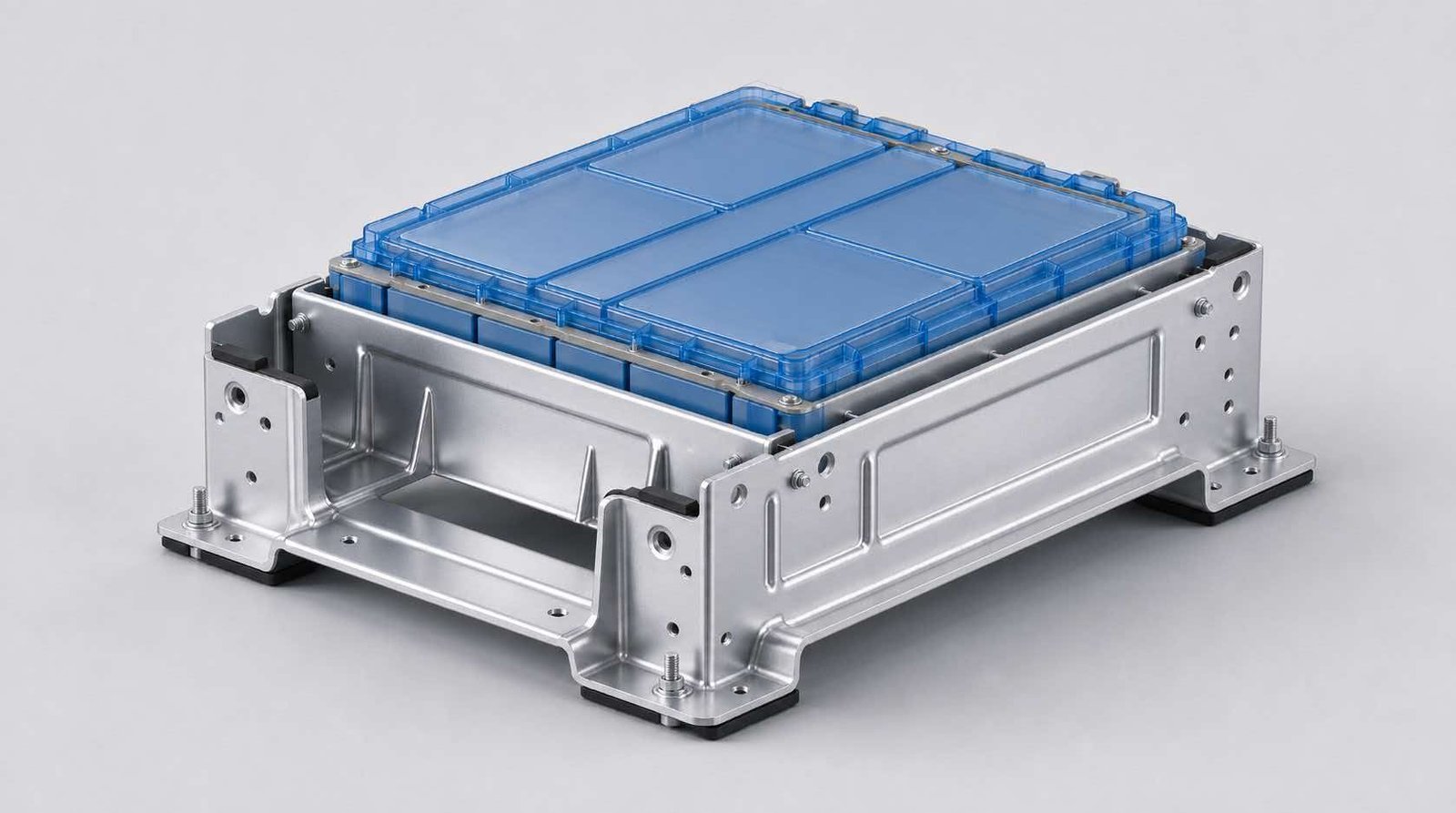
The unit price of a module bracket is low, yet it is the component most likely to become a chokepoint in the storage project delivery chain — no matter how on-time the cabinet is, if the brackets slip, the site still stands still. Handing these high-volume parts to a source factory with stable quality control under a long-term supply agreement is the most common risk-control move made by storage integrators.
Battery module brackets and energy storage cabinet internal structural parts — batch customization available. Fengrun Hardware Factory supports dual punching/laser process routes with one-stop delivery from small batches to mass production. Send your drawings for a quote.
From prototype to production — high-precision sheet metal solutions with fast turnaround and consistent quality


