
-
About Us
-
Metal Fabrication Processes
Precision Sheet Metal Bending Laser Cutting Stamping Welding Surface Treatment -
Contact Us
The PV inverter converts the DC power from the modules into grid-connected AC power, and almost all of them are installed outdoors — on rooftops, in deserts, on saline-alkali land — where blazing sun, temperature swings, salt spray, and sandstorms test its sheet metal enclosure all year round.
In 2026, PV installations in Southeast Asia grew +60% year over year, and Middle East solar-plus-storage investment exceeded one hundred billion USD. As a standard companion part, inverter enclosure demand keeps scaling with module installations. String inverter enclosures are a classic "medium complexity, high volume" category, spanning the full range from single-household to utility-scale.
Component | Thickness | Design Points |
Main housing (top/bottom covers + side panels) | 1.5–2.0 mm | IP66 protection; cooling fins / cooling-hole design |
Heat sink shroud panel | 1.5 mm | Mates with the aluminum heat sink; guides the airflow |
Wiring compartment | 1.5–2.0 mm | Waterproof wiring zone, isolated from the main chamber |
Mounting back panel / hooks | 2.0–3.0 mm | Wall/bracket mounting; load bearing |
Display window panel | 1.2–1.5 mm | Screen + button zone; waterproof light-transmitting window |
Mainstream: SPCC cold-rolled steel + high-specification coating — best cost; corrosion protection carried by the coating system.
Heavy corrosion (coastal / chemical zones): 304 stainless steel — first choice for C4/C5 corrosion-class environments.
Special case: galvalume steel + fluorocarbon coating — the classic combination for the Middle East's high-temperature, high-UV desert environments; 10+ years of weather resistance.
Lightweight: ADC12 die-cast aluminum + sheet metal hybrid — the mainstream form for low-power residential inverters.
Corrosion class reference: C1–C2 (indoor), C3 (ordinary outdoor), C4 (coastal/industrial), C5-M (marine/heavy chemical). Outdoor inverter installations generally require C4 as the starting point — the trio of material + pretreatment + powder determines whether the target is met.
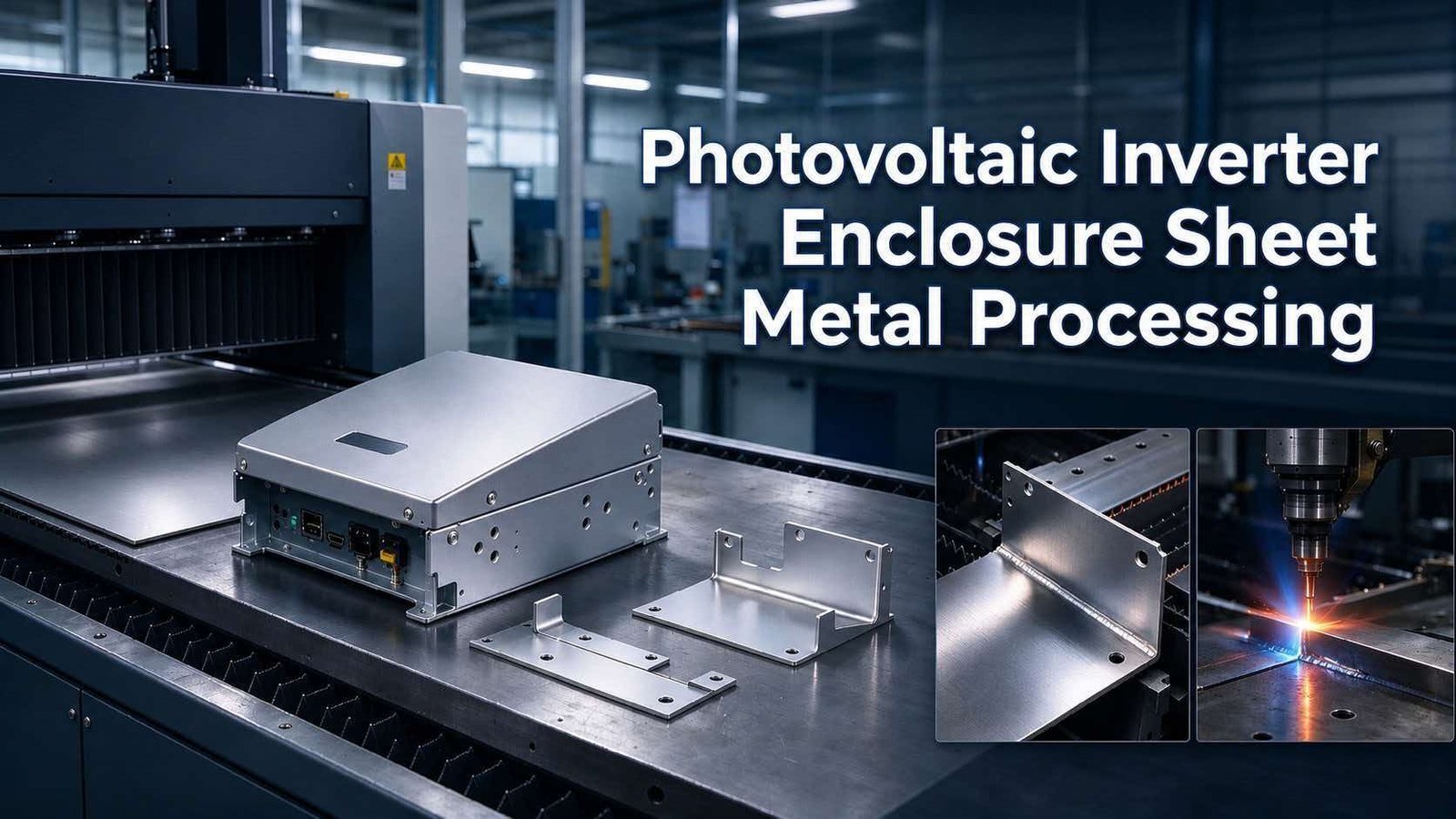
Process chain: laser/CNC punching blanking → bending (uniform R radii) → welded sealing (water-tight weld seams) → pretreatment (ceramic conversion) → outdoor-grade coating → silkscreen → air-tightness inspection.
Challenge 1: IP66-level sealing. The dual test of torrential-rain washdown and condensation from temperature swings: housing joints either get a continuous weld seam + dressing, or one-piece bent forming to reduce joints — the latter demands higher process skill but delivers stronger reliability.
Challenge 2: Making heat dissipation structural. Inverter power density keeps climbing; the position and open ratio of cooling fins and punched-hole arrays on the housing directly determine whether the temperature-rise test can be passed — this requires a factory with thermal-design collaboration experience.
Challenge 3: Outdoor topcoat weatherability. Ordinary polyester powder yellows within 2 years; an outdoor fluorocarbon system (primer powder + topcoat powder) holds color and gloss for 5 years — the coating line's material management determines product life.
Match the material combination to the installation environment: have the factory propose a material + coating scheme based on your project map (coastal? desert? highland?) instead of selling one scheme nationwide. Fengrun Hardware Factory supports machining across galvanized steel, 304 stainless steel, and galvalume steel, and when customizing from drawings can match the anti-corrosion system to your environment class (C3/C4/C5).
Check sealing process details: one-piece bent forming beats weld-and-dress; asking a factory how it handles housing joints immediately reveals its process tier.
Batch consistency: inverters are volume products — orders at the tens-of-thousands-per-month level test automation lines and coating color-difference control.
Solar is the business of turning sunshine into money, and the inverter enclosure is the part that shields the entire device from every hostile element. Every time PV installations double, the baseline orders in this category double with them — it isn't glamorous, but it is as steady as the sun itself.
PV inverter enclosures, string/central inverter sheet metal parts — custom fabrication available. Fengrun Hardware Factory supports the full outdoor anti-corrosion process chain. Send your drawings for a quote; prototyping is fast.
From prototype to production — high-precision sheet metal solutions with fast turnaround and consistent quality


