
-
About Us
-
Metal Fabrication Processes
Precision Sheet Metal Bending Laser Cutting Stamping Welding Surface Treatment -
Contact Us
Standard stamped parts are commodity items — drawings exist, tooling exists, anyone can make them. Custom non-standard work is the opposite: the drawing comes from the customer, the batch size comes from the customer, and the deadline is chased by the customer. One order might be 200 shielding cans; the next, 50,000 brackets; the one after, a 50-piece prototype — with different dimensions and materials every time.
Demand for this category is enormous: equipment manufacturing, home appliances, auto parts, electronics, telecommunications, lighting, furniture hardware — nearly every industry has small metal
components that simply cannot be bought off the shelf and must be custom-made. But it is also the category that tests a factory's overall capability most severely — orders are fragmented, changeovers are frequent, and drawings are endlessly varied. Without a mature flexible-production system, the more orders you take, the faster you lose money.
So the logic for selecting a non-standard stamping supplier is really about selecting the ability to handle fragmented orders.
Type | Typical parts | Common materials | Key process points |
Blanking | Washers, shielding plates, conductive plates | SPCC, copper, phosphor bronze, stainless steel | Punch–die clearance controls burrs; flatness critical |
Spring/clip parts | Battery contacts, contact springs, clips | Phosphor bronze, beryllium copper, stainless steel | Springback compensation; heat-treatment hardness control |
Bent parts | Brackets, supports, mounting seats | SPCC, SGCC, 304 | Bend sequence and interference; hole-position datums |
Drawn parts | Covers, cup-shaped parts, blind shells | SPCC, stainless steel, aluminum | Draw-ratio calculation; anti-cracking and anti-wrinkling |
Press-fit / tapped parts | Plates with press-in nuts, machine-screw bosses | SPCC, stainless steel | Push-out torque; thread go/no-go gauging |
Assemblies | Stamped + welded + riveted combinations | Mixed materials | Assembly tolerance chain; welding distortion control |
One pattern is clear from the table: the difficulty of non-standard stamping never lies in the "stamping" stroke itself, but in the whole chain — tooling and nesting before the press, and bending, riveting, and finishing after it.
Prototyping stage: drawing review (DFM) → laser-cut prototypes (no tooling, 1–5 pieces for fast validation) → manual/simple bending → customer confirmation.
Mass-production stage: sample approval → tooling plan (single-stage or progressive die) → stamping production → deburring → bending / press-riveting / tapping → surface treatment (galvanizing, powder coating, passivation, polishing) → full inspection and packing.
Here is a division of logic most valuable for customers to understand:
Laser cutting suits prototyping, small batches, thick plate, and irregular profiles — no tooling cost, zero cost for drawing revisions;
Stamping tooling suits high volumes — low per-piece cost and excellent consistency, but tooling cost must be amortized across the order.
A mature factory lets the two routes complement each other: use laser to get the sample right first, then assess whether tooling is worth it — rather than pushing you into tooling from day one (to book the tooling fee), or clinging to stamping and pricing small batches absurdly high.
Challenge 1: Whether the drawing review is done thoroughly. Customer drawings often contain details that cannot be stamped as drawn: hole margins too small, inner bend radii too tight, tapped holes too close to bend lines, draw depths beyond limits. A responsible factory flags these before cutting and proposes revisions — fixing a line at the drawing stage saves a whole batch on the line.
Challenge 2: Springback control. Springback in clips and bends depends on thickness, hardness, and bend direction. The same drawing can drift with different material batches — this is where tooling-compensation experience and incoming-material management show.
Challenge 3: Burrs and flatness. Excess burrs on blanked parts scratch wiring harnesses and hinder assembly; a shielding plate with poor flatness loses contact. Punch–die clearance, tooling-wear monitoring, and a deburring step — none of these can be skipped.
Challenge 4: Batch-to-batch consistency. Parts from batch 1 and batch 20 must assemble on the same line. Tooling-maintenance schedules, material lot control, and first-article inspection — the invisible disciplines — determine consistency.
Challenge 5: Small-batch economics. The customer wants 50 pieces: tooling is unrealistic, and laser plus simple bending is the right answer. Yet many factories refuse small orders or quote absurdly. A factory willing to design a process route for small batches is the kind that truly serves the non-standard market.
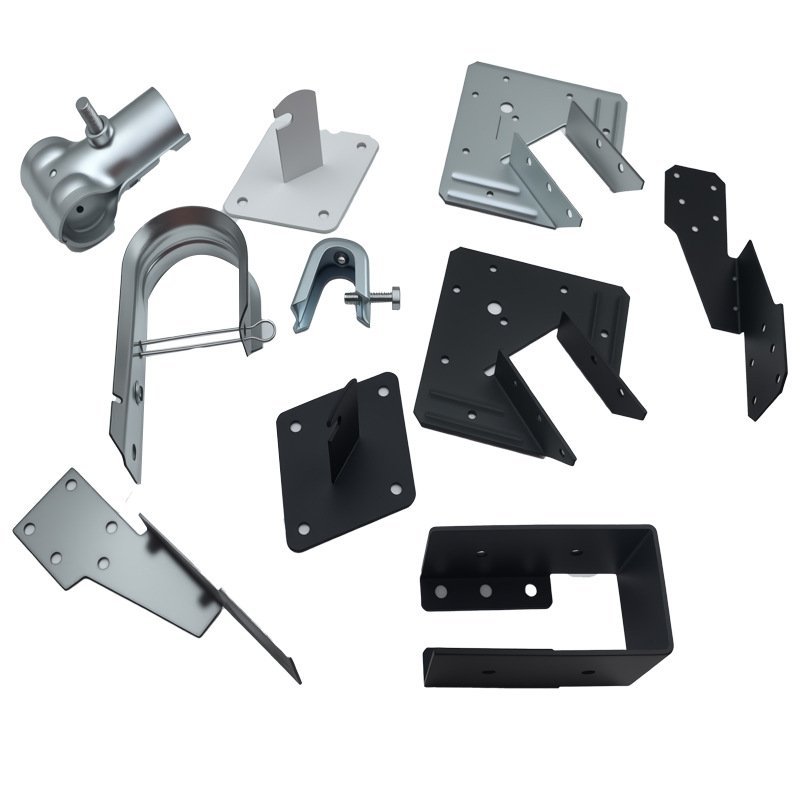
1. Check whether "laser + stamping" dual routes exist under one roof. A stamping-only shop either refuses small batches or quotes the moon; a laser-only shop cannot get high-volume costs down. A source factory like Fengrun Hardware Factory, equipped with both high-speed stamping presses and fiber laser cutting, prototypes by laser with no tooling and shifts to stamping for volume — one factory carries the job from 5 pieces to 50,000, so you never switch suppliers mid-project.
2. Check material coverage. Non-standard parts use everything: cold-rolled steel, galvanized steel, stainless steel, copper alloys, aluminum, in thicknesses from fractions of a millimeter to several millimeters. Fengrun Hardware Factory processes SPCC, SGCC, 304/316 stainless steel, carbon steel, and aluminum alloy, covering 0.5–20 mm, with customization from drawings or samples — so you are not piecing together three suppliers for one project.
3. Check whether surface treatment is closed-loop in-house. Nine out of ten non-standard parts need galvanizing, coating, or passivation. Outsourcing finishing doubles lead time and blurs quality accountability. Fengrun Hardware Factory runs complete in-house surface-treatment lines (polishing, passivation, powder coating, galvanizing) — from blanking to finished part under one roof, with no finger-pointing between two factories when something goes wrong.
4. Check prototyping speed and attitude toward revisions. Ask three questions directly: how long is prototyping? Do drawing revisions cost extra? What is the minimum order quantity? The true reliability of a non-standard stamping supplier hides in the answers to those three questions.
What wins in non-standard stamping is never the most expensive machine on the list — it is systematic flexibility: serious drawing reviews, dual laser and stamping routes, in-house finishing, and treating a small batch like a real order.
Customers' drawings are endlessly varied, but a good factory's response is always the same — treat every "odd drawing" as one more chance to prove itself.
Custom non-standard hardware stamping parts — prototyping from drawings or samples, dual laser/stamping routes, one-stop delivery from small batches to mass production. Send your drawings to Fengrun Hardware Factory for a quote.
From prototype to production — high-precision sheet metal solutions with fast turnaround and consistent quality


