
-
About Us
-
Metal Fabrication Processes
Precision Sheet Metal Bending Laser Cutting Stamping Welding Surface Treatment -
Contact Us
A shelving unit, a set of furniture, a curtain-wall subframe, a section of formwork bracing — what ultimately
determines whether it stands firm is often not the main material, but the dozens of few-dollar brackets holding it together.
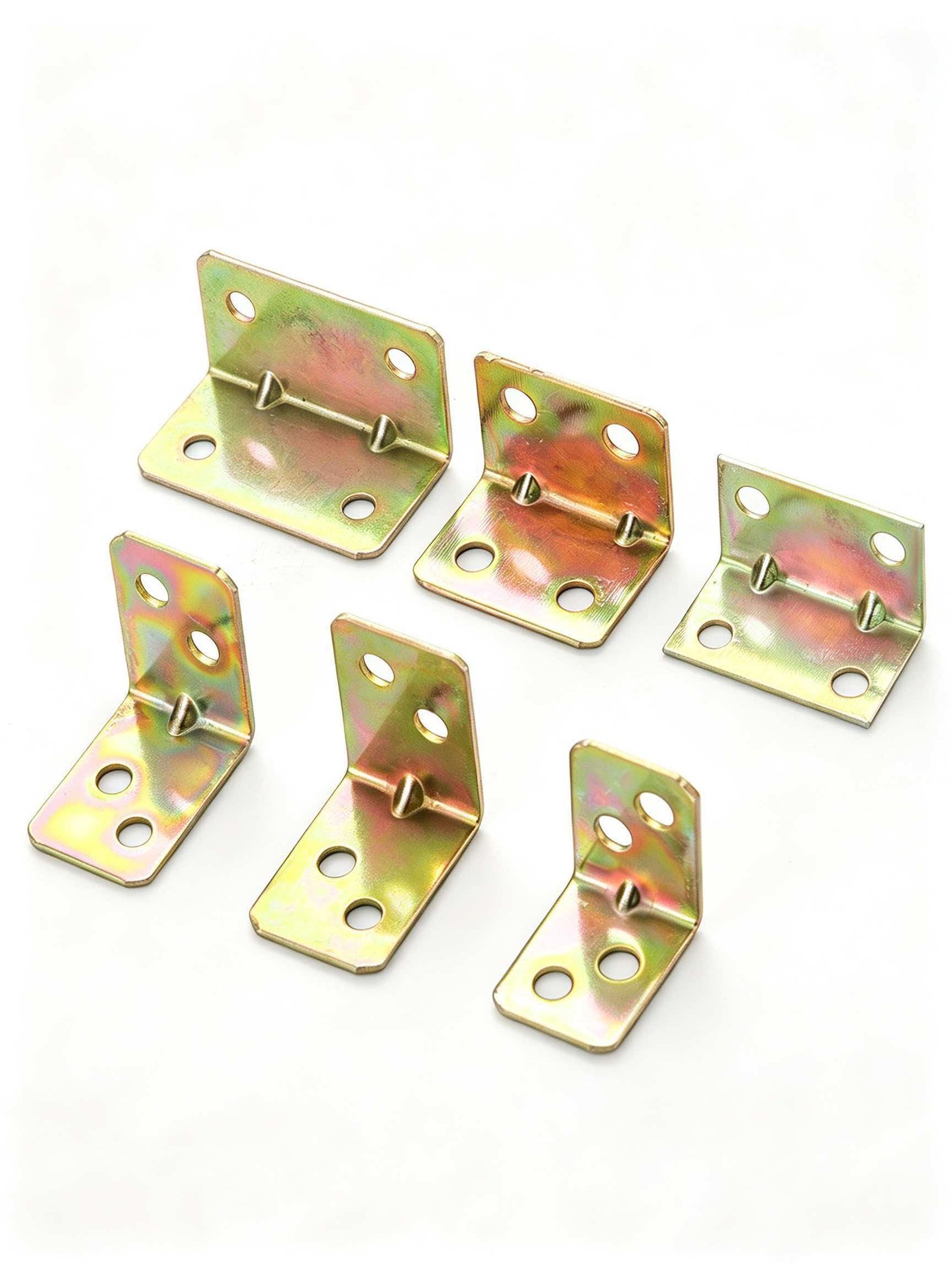
Angle brackets (also called corner brackets, L-brackets, or angle cleats) are among the least "technical" categories in hardware: simple structure, low unit price, a drawing you can read at a glance. Yet anyone who has actually bought them knows the returns never come from "we can't make it" — they come from "this batch isn't the same as the last one." Half a degree off and the frame won't sit flat; ten hundredths of a millimeter off on hole diameter and the screw won't go in; one batch of color zinc darker than the last; rust appearing at the inner corner after two months in storage.
So "heavy-duty" and "color zinc" look like two simple spec modifiers, but each pushes the difficulty up a notch:
Heavy-duty means greater springback, a much harder 90° to hold, and higher risk of cracking at the outside of the bend and distorting holes near the bend line;
Color zinc means that beyond forming, you must control coating thickness, salt-spray duration, batch-to-batch color variation — and one blind spot most people never notice: the inside corner of an L.
One concerns thickness, the other concerns coating. Both test the same thing: process stability.
Bracket drawings all look alike, but the structures differ considerably. Identify yours before discussing process:
Type | Structural feature | Typical use | Common thickness |
Flat punched bracket | L-bend plus 2–4 round holes | Timber connections, panel furniture assembly | 1.5–2.5 mm |
Ribbed bracket | L-bend with embossed stiffening rib | Shelving, load-bearing joints, equipment bases | 2.0–3.0 mm |
Unequal-leg bracket | One long leg, one short leg | Beam seats, shelf supports, panel reinforcement | 2.0–4.0 mm |
Slotted adjustable bracket | Slotted holes allowing installation adjustment | Curtain walls, doors and windows, equipment leveling | 2.0–3.0 mm |
Countersunk bracket | Countersunk or chamfered holes, flush screws | Flush assemblies, exposed structures | 2.5–4.0 mm |
Welded gusset bracket | Bent, then welded with a triangular rib | Heavy structures, formwork, machine frames | 3.0–6.0 mm |
The pattern is clear: as thickness climbs, bending and plating difficulty does not grow linearly. A 1.5 mm bracket looks fine no matter how it's bent. A 3.0 mm bracket held at 90° with batch-to-batch consistency is a different matter entirely.
Thin plate is formed directly to the die angle. Thick plate is not — the thicker the material, the greater the springback. With the same tooling, 2.0 mm and 3.0 mm material can land 1°–3° apart in actual angle, and that drifts further with material lot, yield strength, and rolling direction. This is the root cause of "every part passes inspection, but the batch won't assemble flat."
Holding 90° in production depends on three things. Miss any one and it won't hold:
1. Springback compensation. Work back from the R/t ratio, material yield strength, and measured springback angle to calculate the die angle, so the tool over-bends slightly and the part lands at exactly 90° after release. This is experience plus trial-run validation — not something you can pull off a table.
2. Coining. Apply enough tonnage at the bottom of the bend to "coin" the radius nearly flat against the material thickness, which sharply reduces springback. For heavy-duty brackets that must hold within ±0.5° to ±1°, this is the most reliable route.
3. The process floor for inner radius and hole spacing. Two hard rules:
Inner radius should not be smaller than 0.5× material thickness (carbon steel); for thick plate, 1.0t is recommended — otherwise the outside of the bend is prone to tearing;
The distance from hole edge to bend line should not be less than 2t + R — otherwise the hole is stretched into an oval during bending and the screw won't pass through.
Many drawings look perfectly fine on screen and fail the moment they hit the press brake. The problem isn't on the shop floor — it's whether anyone caught it at the drawing-review stage.
This is the most commonly misunderstood point in purchasing. Color zinc is not paint, and not dyed zinc — it is zinc electroplating followed by a colored chromate conversion coating. The zinc layer provides sacrificial-anode protection; the conversion film provides appearance and additional corrosion resistance; the color comes from interference in the chromate film — yellow-iridescent, rainbow-like.
Item | Blue-white zinc | Color zinc | Black zinc |
Appearance | Silver-white with a blue cast | Yellow-iridescent / rainbow, strong metallic look | Matte black |
Conversion system | Mainly trivalent chromium | Mainly trivalent chromium (environmental); legacy process uses hexavalent | Trivalent chromium plus black dye/conversion |
Neutral salt spray reference | White rust at roughly 12–24 h | White rust at roughly 24–72 h | White rust at roughly 24–48 h |
Relative cost | Lowest | Medium | Medium-high |
Typical use | Internal structural parts | Exposed parts, shelving, furniture, building hardware | Premium visible parts, optical components |
(The salt-spray figures above are common industry reference ranges. Actual performance depends on coating thickness, conversion type, and the customer's acceptance standard — typically GB/T 9799 or ASTM B633.)
There are two real difficulties with color zinc that never show up on a quotation:
Difficulty 1: The inside corner is a plating shadow. On an L-shaped part, current density at the inner corner is low, so the coating is naturally thinner than on flat surfaces, and the conversion film covers incompletely. The result: the outside passes salt spray, and the inside corner rusts first — and the inside corner is precisely the spot that's hidden after assembly and discovered last. The fix is racking-angle optimization, auxiliary anodes, and orienting the inner corner toward the current source. These are exactly the things that make a large difference and that customers cannot see.
Difficulty 2: Batch-to-batch color variation. Color zinc is extremely sensitive to conversion bath temperature, pH, concentration, immersion time, and drying temperature. Even within one plating shop, the morning run and the afternoon run can come out different shades. For exposed parts you must control it with a master color chip for comparison plus retained samples from every lot — never by eye and "close enough."
There is also a compliance point that is easy to overlook: products exported to the EU must use trivalent chromium conversion (hexavalent chromium is restricted under RoHS). If this isn't written on the drawing, the consequence is an entire shipment turned back at the border.
Cutting → punching / notching → deburring → 90° bending (coining) → first-article angle and hole-position inspection → welding (reinforced types) → pretreatment (degreasing, pickling, activation) → zinc electroplating → colored chromate conversion → sealing / drying → hydrogen de-embrittlement (high-strength parts) → appearance and coating-thickness sampling → packing
Three steps that are easy to cut and should never be:
Deburring: burrs take plating poorly, salt spray starts rusting right at the burr tip, and burrs cut hands and wire harnesses during assembly;
Pretreatment: in salt-spray failures, the root cause is far more often inadequate degreasing or over-pickling than insufficient coating thickness;
De-embrittlement: for parts with tensile strength above 1,000 MPa or high hardness, baking must follow plating promptly (typically around 200°C for 2–4 hours, per the material and customer standard). Skip it and delayed cracking becomes possible — and the fracture tends to appear days to weeks after installation, which is the hardest kind of failure to trace.
Symptom | Common root cause | Corrective action |
90° angle out of tolerance, inconsistent across the batch | Springback not compensated, no coining | Back-calculate die angle, switch to coining, add angle gauges |
Cracking at the outside of the bend | Inner radius too small, insufficient elongation, bend line parallel to rolling direction | Increase inner radius to 1.0t, change material or nesting orientation |
Holes near the bend line turn oval | Hole margin below 2t + R | Revise hole position or punch after bending |
Inside corner rusts first | Thin coating at inner corner, incomplete conversion coverage | Improve racking and auxiliary anodes, add coating-thickness checkpoints |
Color zinc varies from batch to batch | Conversion bath parameters drifting, unstable drying temperature | Master color chip comparison, retain samples per lot, lock bath parameters |
Salt spray fails although coating thickness passes | Poor pretreatment, damaged conversion film | Recheck degreasing and pickling, avoid handling damage after conversion |
Fracture days after assembly | High-strength parts not de-embrittled | Bake within 1–4 hours of plating |
Take this table straight to your supplier. If the answers line up, they have genuinely run heavy-gauge brackets. If they don't, they have run thin ones.
In this category, quotations can differ by 20–30%, but the real difference sits outside the quotation. Here is how Fengrun Hardware Factory approaches this product line — the five questions below map directly onto it, and you can use them as a checklist:
1. "For heavy-gauge parts, do you just bend, or do you coin? Do you have angle gauges?"This is the first dividing line. Bending 3.0 mm brackets with ordinary tooling guarantees the angles will drift across a batch. Fengrun Hardware Factory runs CNC bending and high-speed stamping equipment and handles material from 0.5 mm to 20 mm; heavy-gauge parts go through coining with first-article angle confirmation, so 90° is held within a batch-controllable band instead of being "whatever comes off the press."
2. "Is your color zinc trivalent or hexavalent? Can you issue a compliance statement for export?"One question eliminates a whole tier of shops still running legacy processes. Trivalent color zinc is the baseline for the EU market and the mainstream choice today.
3. "Will you put the salt-spray requirement in the contract? How many hours to white rust, how many to red rust?"A factory willing to write salt spray into the contract usually runs disciplined pretreatment. One that only promises verbally, "ours won't rust," usually hasn't tested it. An acceptance criterion on paper beats any promise.
4. "Is plating done in-house or outsourced? If outsourced, can you trace the plater and the lot?"Outsourcing is not the problem — traceability is. Fengrun Hardware Factory operates a complete in-house surface-treatment line (polishing, passivation, powder coating, zinc plating), so the chain from cutting through plating and conversion closes inside the plant. Color and salt spray stay under our own control, and when something goes wrong there's no shuttle of blame between two factories.
5. "Do you take small batches? How many days to sample? Do you charge for drawing revisions?"The real order pattern for brackets is almost always: 200 pieces to trial-fit, then 50,000 once it works. A factory that only takes volume orders pushes the entire cost of trial and error onto the customer. Fengrun Hardware Factory accepts custom work from drawings or samples, and covers everything from small-batch sampling to volume delivery — so you don't have to find a second supplier just to get a trial run.
A heavy-duty color-zinc-plated 90-degree L-bracket may sell for a few dimes to a few dollars, yet it carries three things at once: the angle decides whether it assembles, the coating decides how long it lasts, and consistency decides whether this batch can be mixed with the last.
The most expensive machine on the equipment list is not necessarily the deciding factor. What actually separates factories is whether someone reviews the drawing, whether the bend is coined, whether anyone owns the coating at the inner corner, and whether the color zinc is compared against a master chip. Customers can't see these small moves on a quotation — but they will see them on site two years later.
Heavy-duty color-zinc-plated 90° L-brackets and related connector hardware — custom-made from drawings or samples, 0.5–20 mm plate capability, bending, stamping, and zinc/chromate finishing closed in-house, one-stop delivery from small batches to volume. Fengrun Hardware Factory welcomes your drawings for quotation and sampling.
From prototype to production — high-precision sheet metal solutions with fast turnaround and consistent quality