
-
About Us
-
Metal Fabrication Processes
Precision Sheet Metal Bending Laser Cutting Stamping Welding Surface Treatment -
Contact Us
This industry has an awkward reality: the structural designs converged long ago. The only thing left that separates one rack from another is the components.
Freestanding wing-type, X-frame scissor, wall-mounted folding, manual-crank lifting — a handful of mainstream structures reshuffled endlessly. Yet what the consumer experiences at home differs completely. Two folding racks at the same two-hundred-yuan price point: one still stands firm after three years, the other has a pivot so loose it wobbles within six months. One latch opens with a light press, the other needs two hard slaps before it locks. One keeps its white powder coating through a full summer on the balcony, the other blisters and peels inside a year.
Every one of those differences lives in the components — not on the assembly line.
So for a finished-goods manufacturer or a brand owner, choosing a parts supplier is really choosing the repair rate of the finished product. And the worst move in this category is consolidating through a trading company: a dozen parts pulled together from three or four different factories, only to find at assembly that the tolerances don't match, the colors don't match, and the delivery dates don't match either.
This article covers exactly that: what the metal parts in a folding drying rack actually are, which ones fail most often, where the cost difference between a source factory and a trading company really sits, and what to ask a source factory.
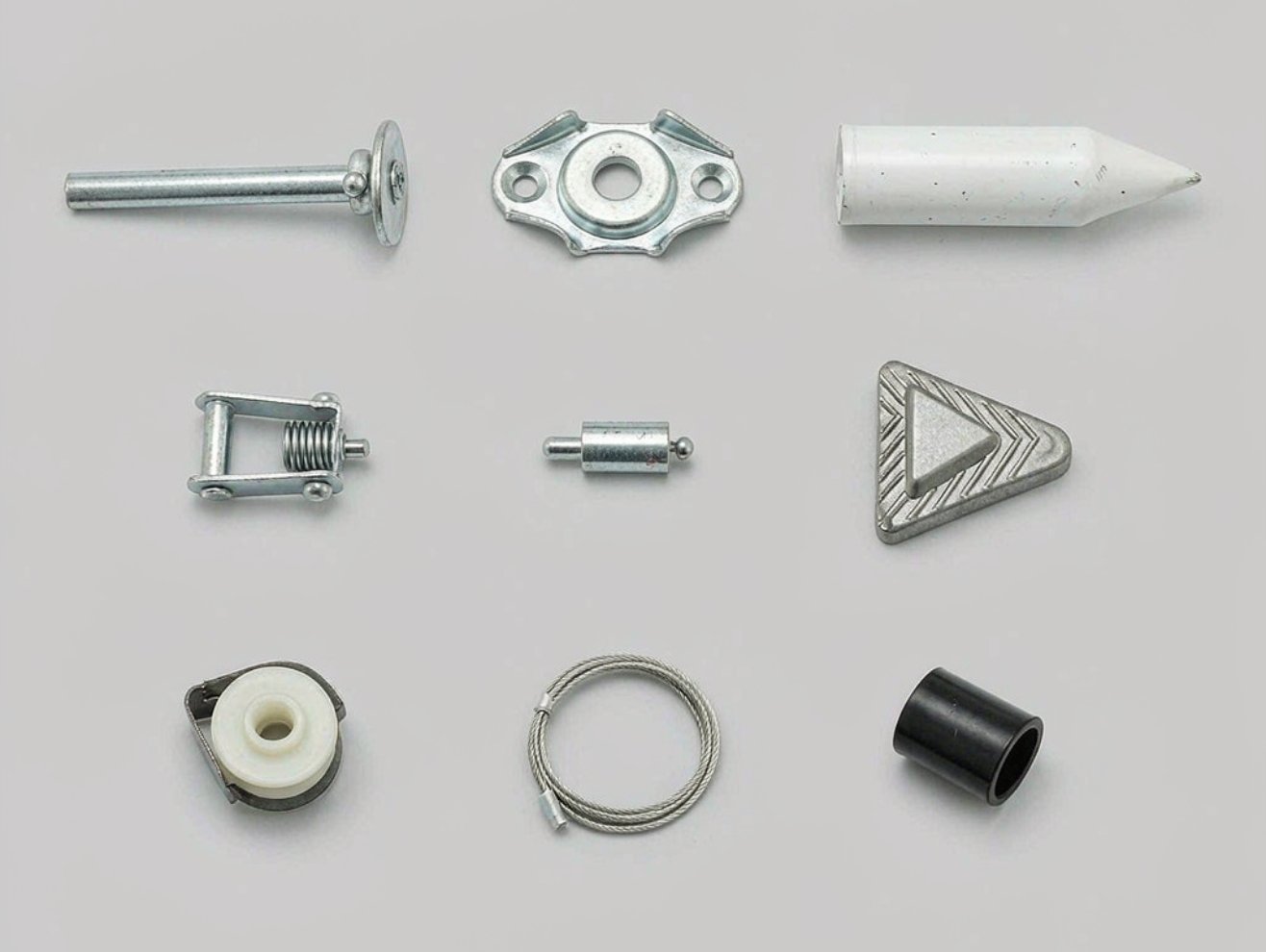
Taking the most common freestanding wing-type rack as an example, the metal parts break down roughly as follows:
Component | Structure / process | Key indicators | Common material |
Pivot pin / hinge shaft | Riveted shaft, pin with circlip, bolt shaft | Fit clearance, shear strength | Zinc-plated carbon steel, stainless steel |
Hinge lug / connecting plate | Stamped and bent, often with flanged holes | Hole tolerance, bearing area at hole | SPCC 1.5–3.0 mm |
Main support tube / hanging rail | Round, square, or oval tube | Wall-thickness uniformity, straightness | Carbon steel, 6063 aluminum, 304 |
Folding latch / self-locking catch | Stamped part plus spring, or zinc die casting | Locking force, wear life | Zinc alloy, SPCC, stainless steel |
Ball detent pin / spring pin | Standard or custom | Spring force consistency, retention | Zinc-plated carbon steel, stainless steel |
Gusset / corner brace | Stamped | Weld quality, flatness | SPCC 2.0–3.0 mm |
Pulley / guide wheel (lifting type) | Stamped bracket plus nylon wheel | Rotation resistance, groove wear | SPCC, zinc alloy |
Steel cable and ferrule (lifting type) | Crimped | Crimp pull-out strength, no loosening | Galvanized steel cable, aluminum ferrule |
Hook / hanging ear | Stamped and bent | Load capacity, no sharp edges | SPCC, stainless steel |
Tube plug / end cap / foot pad | Injection molded or stamped | Interference fit, retention | PP/TPR, SPCC |
One look at the table makes it clear: only three or four parts in a finished rack actually carry load — the pivot, the hinge lug, the support tube, and the latch. And those are precisely the parts that decide whether the rack lasts three years or wobbles in six months.
First, pivot wobble — the number one source of returns.
What the consumer calls "wobble" is, in engineering terms, excessive clearance in the hinge joint. It comes from four places: pivot pin diameter tolerance, hinge lug hole tolerance, insufficient lug thickness causing the hole to deform under load, and riveting that is too loose.
Radial fit clearance is normally held at 0.05–0.15 mm: too much and it wobbles, too little and it seizes — and powder coating eats further into that clearance afterward;
Thin-plate lugs must use flanged (extruded) holes or bushings (nylon or bronze), converting the bearing surface from "the cylinder wall of the material thickness" into "an extended cylinder after flanging." Without this, a few hundred cycles will wear the hole into an oval;
Riveted pivots control axial clearance through riveting force. Unstable force means some units in the same batch come out tight and others loose.
The most direct way to gauge a factory's level: ask how much clearance they leave before powder coating. Anyone who can answer "allowing for 60–90 μm film thickness per side" has genuinely built these assemblies. Anyone who can't is simply machining to the drawing.
Second, latch failure — the most dangerous problem.
A folding rack's latch must lock reliably when deployed: shaking, hanging a load of wet laundry, and wind must not release it. Three failure paths:
Insufficient catch depth or an oversized radius, letting it slip out under load;
Spring force decay that no longer holds after a few hundred cycles (spring material and heat treatment are what matter — wire diameter alone is not);
Wear on the catch pawl of a zinc die casting, rounded off within six months.
These problems cannot be caught by finished-goods inspection. Only cycle testing finds them — run several thousand open-close cycles, then measure locking force again. Common industry acceptance is that function remains normal after 5,000–10,000 cycles; the specific figure should follow the customer's standard.
Third, load-bearing tear-out — the price of saving material.
On a freestanding wing-type rack rated 15–30 kg, the hinge lugs see combined shear and bending stress at full load. Dropping lug thickness from 2.5 mm to 1.8 mm to save material may still pass a static test, but after repeated loading it cracks from the hole edge. That isn't a material failure — it's a safety factor that got eaten.
Fourth, powder coating peel — the harshest real-world test is a balcony.
A drying rack sits in sun, humidity, and laundry-detergent residue year-round — a semi-outdoor duty. Peeling almost never traces back to powder quality. It traces to pretreatment: incomplete degreasing, no phosphating or zirconium conversion film formed, or parts entering the booth with rust on them.
The correct sequence is: degrease → rinse → descale → rinse → conditioning → phosphating or zirconium conversion → rinse → dry → electrostatic powder coating → cure. Film thickness is typically built to 60–90 μm, adhesion verified by cross-hatch test (GB/T 9286 or ASTM D3359), with impact and bend tests run alongside. Skip one rinse step and salt-spray life drops by half.
Fifth, tube-edge burrs — a consumer-safety red line.
A drying rack is a household consumer product. Burrs on tube ends and blanked edges are both a cut hazard and the source of a "cheap" feel. Tubes must be deburred and chamfered, blanked parts must pass through a deburring operation, and weld spatter must be cleaned off. This costs very little, but plenty of factories skip it to save labor — and it is the first thing a consumer's hand touches.
Option | Characteristics | Suitable parts | Watch out for |
Carbon steel + powder coating | Lowest cost, full color freedom | Support tubes, lugs, gussets | Pretreatment determines life; cut edges and hole interiors need touch-up |
Carbon steel + zinc plating (blue-white / color zinc) | Low cost, conductive, protects interior surfaces | Pivots, pins, internal structural parts | Appearance is plain; unsuitable for exposed parts |
Zinc plating + powder coating (dual layer) | Best corrosion resistance, suits humid regions | Premium models, exports to Northern Europe or coastal markets | Higher cost; control total film build-up |
Aluminum 6063 + anodizing | Light, rust-free, good hand feel | Hanging rails, exposed tubes | Load-bearing areas need thicker wall or an internal insert |
Stainless steel 304 | No finishing needed, long life | Pivots, hooks, coastal-market models | High cost; work-hardens noticeably, strong springback |
A practical rule: exposed parts go "aluminum anodized or powder coated," load-bearing parts go "carbon steel plus zinc plating." That pairing is the best value — don't force load-bearing parts into aluminum just for process uniformity, and don't strip exposed tubes down to bare zinc plating just to save money.
Tube parts: tube cutting → deburring/chamfering → punching/notching → tube bending (radius and springback compensation) → welding (thin-wall tube needs current control to prevent burn-through) → grinding → surface finishing
Stamped parts: laser cutting or blanking → punching (including flanged holes) → bending → deburring → riveting/press-fitting → surface finishing
Assemblies: kitting → riveting/bolt assembly → open-close testing → load sampling → packing
Here is the integration logic that only a source factory can deliver:
A drying rack's parts are not one part — they are a combination of tube work, stamping, spring parts, and surface finishing. Split the order across suppliers and the tolerance chain passes through three factories, with nobody owning a problem when it appears. Only when one factory runs from tube cutting through powder coating does the tolerance chain actually close.
This isn't explained by "no middleman" alone. The gap comes from four specific places:
1. Tooling and sampling fees. A trading company takes the order and passes it to a factory, which charges tooling once; the trading company adds a layer. A source factory quotes tooling directly, and a drawing revision is billed once.
2. Logistics and loss in surface finishing. Outsourcing powder coating means round-trip freight, handling damage, and secondary packaging — plus the classic outcome of "it comes back coated and no longer fits" (film build eating the clearance).
3. Rework cost in the tolerance chain. Tubes from one shop, lugs from another; when the holes don't line up, both the rework cost and the question of who pays are hidden expenses.
4. Attitude toward small batches. A source factory can start from a 200-set trial run. A trading company usually has to reach a factory's minimum order quantity — small orders are either refused or marked up.
In one line: a source factory sells integration capability; a trading company sells an information gap. In a market as commoditized and price-transparent as this one, there is very little gap left to sell.
Start with a capability table — Fengrun Hardware Factory's configuration for this kind of hardware maps directly onto the six questions below, so you can use them as a checklist:
Item | Detail |
Core business | Sheet metal parts, stamped parts, and metal tube fabrication; custom work from drawings or samples |
Working range | Sheet and tube thickness 0.5–20 mm |
Key processes | Fiber laser cutting, CNC bending, high-speed stamping, precision welding |
Surface finishing | Zinc plating, passivation, electrostatic powder coating, polishing — all in-house |
Common materials | SPCC/SGCC cold-rolled and galvanized sheet, carbon steel, 304/316 stainless steel, aluminum alloy |
Order profile | Small-batch trial production through volume delivery, one-stop |
1. "Are the tube work, stamping, and surface finishing all done inside your plant?"This is the first test of "source." Fengrun Hardware Factory runs laser cutting, CNC bending, high-speed stamping, precision welding, and a complete in-house surface-treatment line (zinc plating, passivation, powder coating, polishing), so the chain from tube cutting and stamping through powder coating closes inside the plant. The 0.5–20 mm range covers both the tubes and the lugs a drying rack needs, and the tolerance chain never has to cross a factory boundary.
2. "How much clearance do you leave at the pivot before powder coating?"This question reveals real experience fastest. A factory that proactively calculates film-thickness compensation has assembled finished products — not just machined to drawing.
3. "How do you control wobble — flanged holes, bushings, riveting force?"Willingness to discuss all three shows they understand where wobble comes from. A factory that only says "our tolerances are accurate" usually has never done a repair analysis.
4. "Do you run open-close cycle testing? How many cycles — because the customer asked, or because you do it by default?"A factory that raises cycle testing on its own generally has a more complete quality system.
5. "Do you take small trial runs? What's the minimum? Do you charge tooling for drawing revisions?"Folding racks are highly seasonal: you need to ramp fast before peak season and run small trials on new structures in the off-season. Fengrun Hardware Factory accepts custom work from drawings or samples and covers everything from small-batch trial to volume delivery, so you don't have to find a second supplier for a 200-set run.
6. "Can you hold color variation on exposed parts against a master chip?"A drying rack is a visible product. Within a batch the white must be the same white, and across batches even more so. Requiring master-chip comparison and retained samples is the cheapest insurance available.
In the folding drying rack category, room for structural innovation keeps shrinking. The real competition has moved down the chain to the components: whether the pivot is tight, whether the latch holds, whether the coating peels, whether the tube end cuts a hand.
Not one of these metrics appears on the finished product's marketing page. Every one of them shows up in a customer review three years later. And whether they hold depends on a single thing: whether the parts are made start to finish by one source factory that understands assembly.
Folding drying rack metal parts — pivot pins, hinge lugs, latches, support tubes, gussets and more. Custom-made from drawings or samples; tube work, stamping, welding, and surface finishing closed in-house; one-stop from trial batch to volume delivery. Fengrun Hardware Factory welcomes your drawings or samples for quotation and prototyping.
From prototype to production — high-precision sheet metal solutions with fast turnaround and consistent quality


